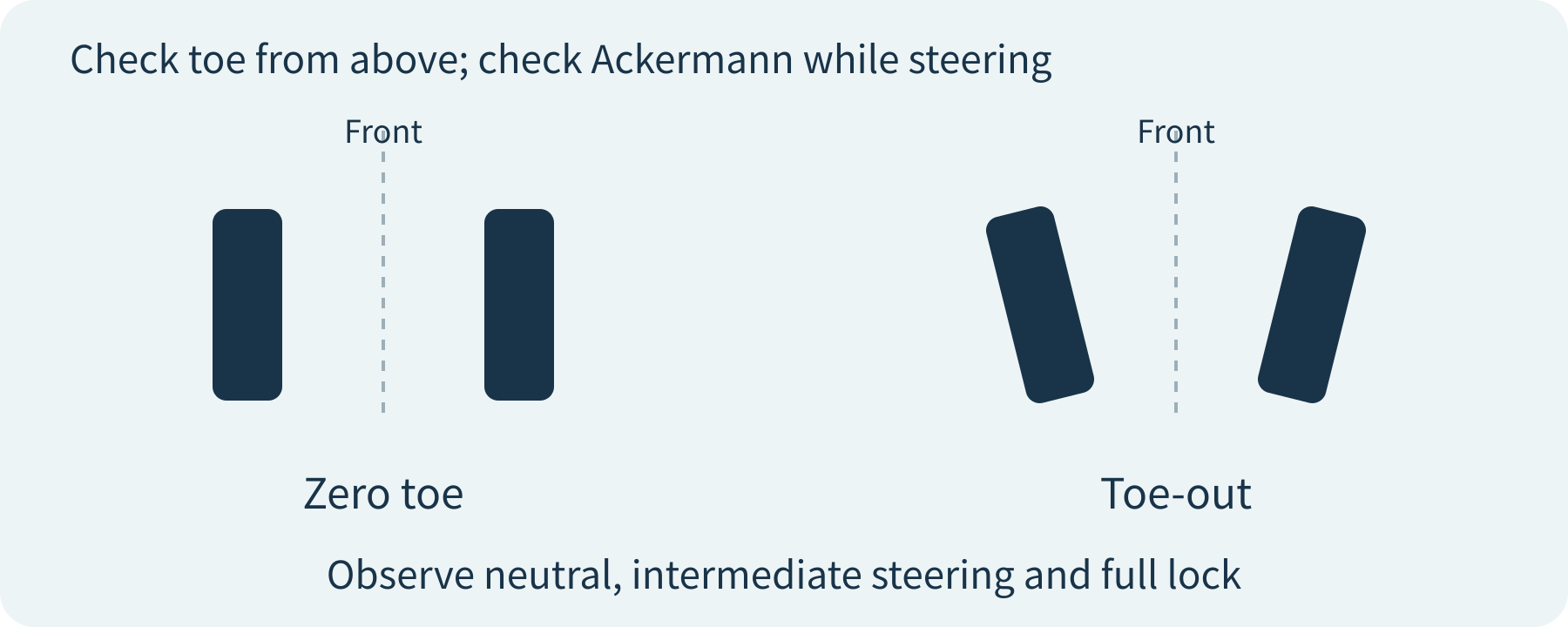
Wheel direction at neutral and the relationship between the wheels while steering are different checks. Separating them makes front-end tuning easier to understand.
This topic-by-topic RC drift series draws on public posts from ReveD Takahiro Blog. Links identify points drawn from the original articles; the practical test routines are editorial suggestions. This series has not been reviewed or endorsed by the original author or manufacturer.
Toe and Ackermann answer different questions
Takahiro compares zero toe and toe-out in terms of steering response and the tendency to wander or hunt. The useful setting is a balance, not simply the one that feels most immediate. [1]
His Ackermann discussion covers adjustment points at the bellcrank or rack and the steering knuckles. Hole positions and shim arrangements depend on the steering geometry, so a setting from another chassis is not automatically transferable. [2]

Check assembly before tuning around a problem
An RDX assembly note uses the prescribed mounting orientation as the baseline and points out possible interference when a lower arm is reversed. [3]
Editorial suggestion: compare the assembly with your chassis manual before trying to compensate with another adjustment. A mechanical interference problem should be corrected at its source.
Look beyond full steering lock
Check wheel direction at normal ride height. Then observe neutral, intermediate steering and maximum steering in both directions. Look for interference involving wheels, ball ends and nearby parts. Take before-and-after photos from the same position.
The car uses intermediate steering angles throughout a run. A front end that looks convincing at full lock may behave differently during entry or transitions.
Describe the symptom precisely
| Vague description | A repeatable observation |
|---|---|
| “The front feels strange.” | The car oscillates on the same straight. |
| “It will not turn.” | It runs wide at the same corner entry. |
| “There is too much steering.” | More corrections are needed after the same transition. |
These observations are not a diagnosis. Gyro and servo behavior can also affect the result. Keep the test conditions consistent and change one item at a time.
On your next run: Identify where the problem begins and which steering range is in use before choosing an adjustment.
Leave a Reply